

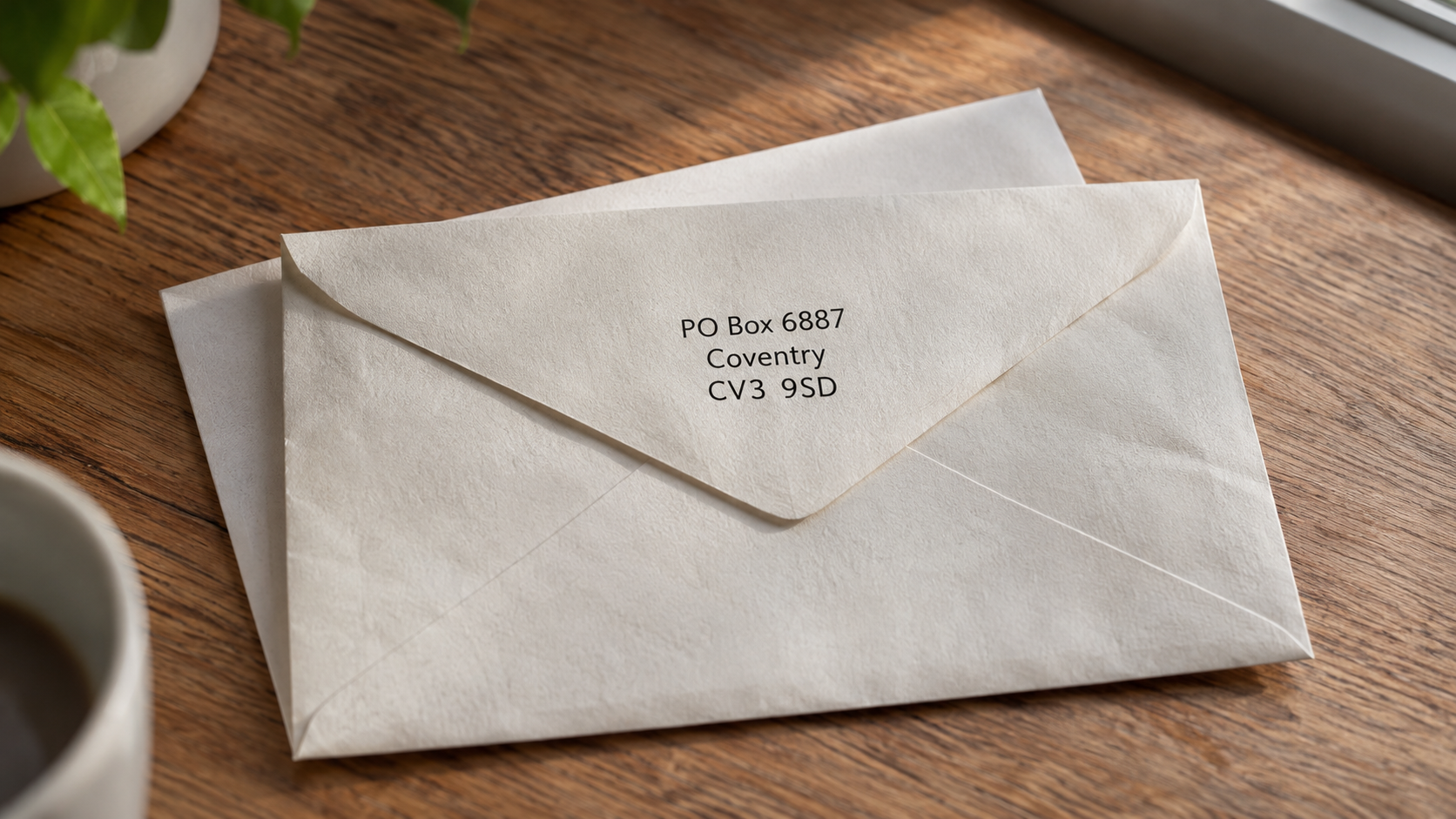
PO Box 6887 Coventry CV3 9SD appears in recipient reports as a return address on business correspondence. It does not reliably identify one sender, and the address alone cannot tell you whether a letter is genuine. Check the organisation named inside the letter before replying, paying or sharing personal information.
Reports connect the address with different types of mail, including healthcare and parking correspondence. However, there is no clear official confirmation in the sources reviewed establishing the current holder of this particular PO Box. The useful distinction is between the organisation writing to you and the service handling its envelopes.
What the address tells you—and what it does not
A PO Box is a numbered postal address. Royal Mail offers services through which the holder can collect incoming mail or have it delivered to an agreed address. It is therefore not necessarily the street address of the organisation using it.
For PO Box 6887, the recipient-submission website Who Wrote Me records the address as:
PO Box 6887
Coventry
CV3 9SD
Its entry describes an envelope carrying an instruction not to use the return address for correspondence. That detail matters: a destination for undeliverable envelopes may be different from the address for customer enquiries, complaints or appeals.
The entry associates examples with an iMail Comms returns department, NHS appointments and parking correspondence. These are recipient reports, not an official register of users or proof of current ownership. The website itself warns that one reported envelope does not establish what every matching envelope contains.
Why iMail Comms and Micom appear in explanations
The reported iMail connection has a plausible operational explanation: businesses can outsource the production and dispatch of their letters.
Micom’s own description of its hybrid-mail service explains that organisations can upload letters electronically for printing and dispatch. In such an arrangement, the business responsible for the message and the company producing the physical mail have different roles. This explains how a postal-processing location can differ from the sender’s own location; it does not, by itself, establish who holds PO Box 6887.
There is also a verified company-name change worth knowing. Companies House lists company number 13535125 as MICOM TECHNOLOGIES LTD, with IMAIL COMMS LIMITED recorded as its previous name until 27 June 2025.
The registered office is Unit 3 Manor Park Industrial Estate, Quinn Close, Coventry, CV3 4LH. That is a separate address from the PO Box discussed here. The company record confirms the legal identity and name history, but does not identify PO Box 6887 as its registered office or confirm ownership of it.
How to identify the sender of your letter
If the letter is addressed to you, start with its contents rather than an online list of possible senders.
Look for:
- The organisation’s full name: including the company, public body or healthcare provider responsible for the message.
- The reason for contact: such as an appointment, account update, payment request or notice.
- A reference number: something the organisation can use to locate the correspondence.
- The response instructions: these may give a different address or an online route.
- Any stated deadline: record it while you check the letter.
Then contact the named organisation through a channel you already trust. Use its established app, an earlier genuine statement or a website you navigate to independently. Ask whether it issued the letter and whether the requested action is correct.
Take Five, the UK fraud-prevention campaign, recommends checking unexpected requests through independently obtained contact details and resisting pressure to pay or disclose information immediately.
For a payment request, verify both the sender and the payment instructions. A familiar company name does not establish that the bank details, website or QR code printed beneath it are genuine.
Does this address mean a scam or a debt?
Neither conclusion follows from the PO Box.
A postal address is not an authentication check. Equally, an unfamiliar return address is not enough reason to discard a letter. The practical question is whether the organisation independently confirms the message and the action it asks you to take.
Treat unexpected pressure, requests for passwords or one-time passcodes, and changed payment details as reasons to pause and check. These are among the warning signs identified by Take Five. If you have already lost money or disclosed sensitive banking information, contact your bank immediately.
If the contents concern a parking charge or an alleged debt, use the issuing organisation’s verified contact and response process. Keep the envelope and letter together, and investigate promptly rather than allowing uncertainty about the return address to distract from the notice itself.
Should you write back to PO Box 6887?
Do not assume the envelope’s return address is the correct reply address. Check for wording restricting its use, and follow the response instructions after verifying the sender.
For a complaint, appeal, completed form or supporting document, confirm the correct destination with the organisation handling the matter. Use the full postcode it confirms rather than substituting a postcode found in an online article.
A PO Box also should not be treated as a walk-in customer-service location. If you need to speak to someone, contact the organisation responsible for the letter. Royal Mail’s PO Box service concerns receiving and collecting post; it does not establish a public reception desk for the sender.
Sources
- Who Wrote Me — “PO Box 6887 Coventry CV3 9SD.” Recipient-submitted envelope descriptions; used as reported examples, not ownership confirmation. Read the entry.
- Royal Mail — “Royal Mail PO Box®.” Official explanation of collection and delivery options. Read the service page.
- Companies House — “MICOM TECHNOLOGIES LTD,” company number 13535125. Official register showing the registered office and previous company name. View the company record.
- Micom — “Still Using Hybrid Mail? Upgrade Your Provider.” First-party explanation of its hybrid-mail service. Read the service description.
- Take Five — “Protect yourself.” Guidance on checking unexpected requests and recognising fraud warning signs. Read the guidance.
